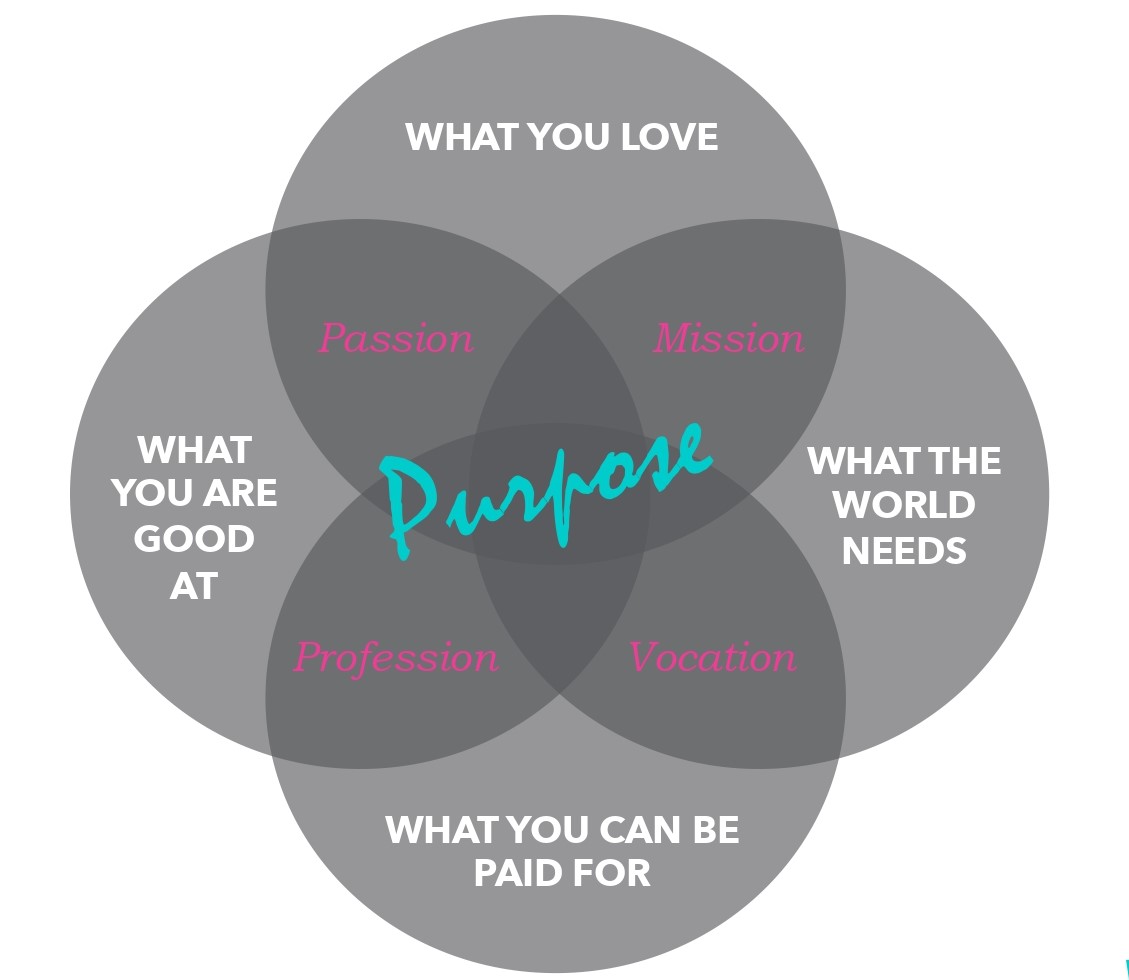
The image presents a powerful and widely recognized framework for understanding “purpose” through the intersection of four essential dimensions of life: what you love, what you are good at, what the world needs, and what you can be paid for. At the center of this overlap lies purpose—a state where passion, talent, service, and sustainability converge.
At the top of the diagram is “what you love.” This represents your passions—the activities that energize you, bring you joy, and make time feel irrelevant. Passion alone, however, is not enough. Many people pursue what they love, but struggle when it does not align with practical realities or societal needs.
On the left side is “what you are good at.” These are your skills, strengths, and natural abilities. When what you love overlaps with what you are good at, you find passion. This is a powerful combination, but it can still feel incomplete if it lacks direction or external relevance.
On the right side lies “what the world needs.” This dimension introduces meaning and impact. When what you love intersects with what the world needs, it forms a mission. This is where personal fulfillment begins to extend beyond the self, contributing to society in a meaningful way. However, without the ability to sustain oneself financially, even the most noble mission can become difficult to maintain.
At the bottom is “what you can be paid for.” This represents economic value—the ability to turn your skills or services into income. When what you are good at meets what you can be paid for, you have a profession. Similarly, when what the world needs aligns with what you can be paid for, you discover a vocation. These combinations bring structure and financial stability but may lack emotional fulfillment if disconnected from passion.
The true essence of purpose lies at the intersection of all four elements. It is not simply about doing what you love or earning a living; it is about integrating passion, competence, societal contribution, and financial viability into a unified whole. When all these areas overlap, work becomes more than a job—it becomes meaningful, sustainable, and deeply fulfilling.
This framework also highlights why many people feel stuck or unfulfilled. Someone may have a well-paying profession but lack passion, leading to burnout. Another person may follow their passion but struggle financially. Others may feel driven by a mission but lack the necessary skills to execute it effectively. Purpose requires balance, not dominance of one element over the others.
Importantly, discovering purpose is not a one-time event but an evolving journey. As individuals grow, their passions, skills, and opportunities change. What the world needs also shifts over time. Therefore, the purpose should be revisited and refined regularly.
In practical terms, this model encourages self-reflection. It challenges individuals to ask critical questions: What truly excites me? What skills do I possess or can I develop? How can I contribute to solving real problems? And how can I sustain myself while doing so?
Ultimately, the image reminds us that purpose is not found by accident. It is built at the intersection of intention, capability, contribution, and reward. Those who actively seek alignment among these four dimensions are more likely to experience a life of clarity, impact, and lasting fulfillment.