The world of accounting and finance is undergoing a remarkable transformation. What began as a profession centered on handwritten ledgers and manual bookkeeping has evolved into a technology-driven field powered by advanced software and, increasingly, artificial intelligence (AI). The future of accounting will not simply be about numbers—it will be about strategy, innovation, and intelligent decision-making.
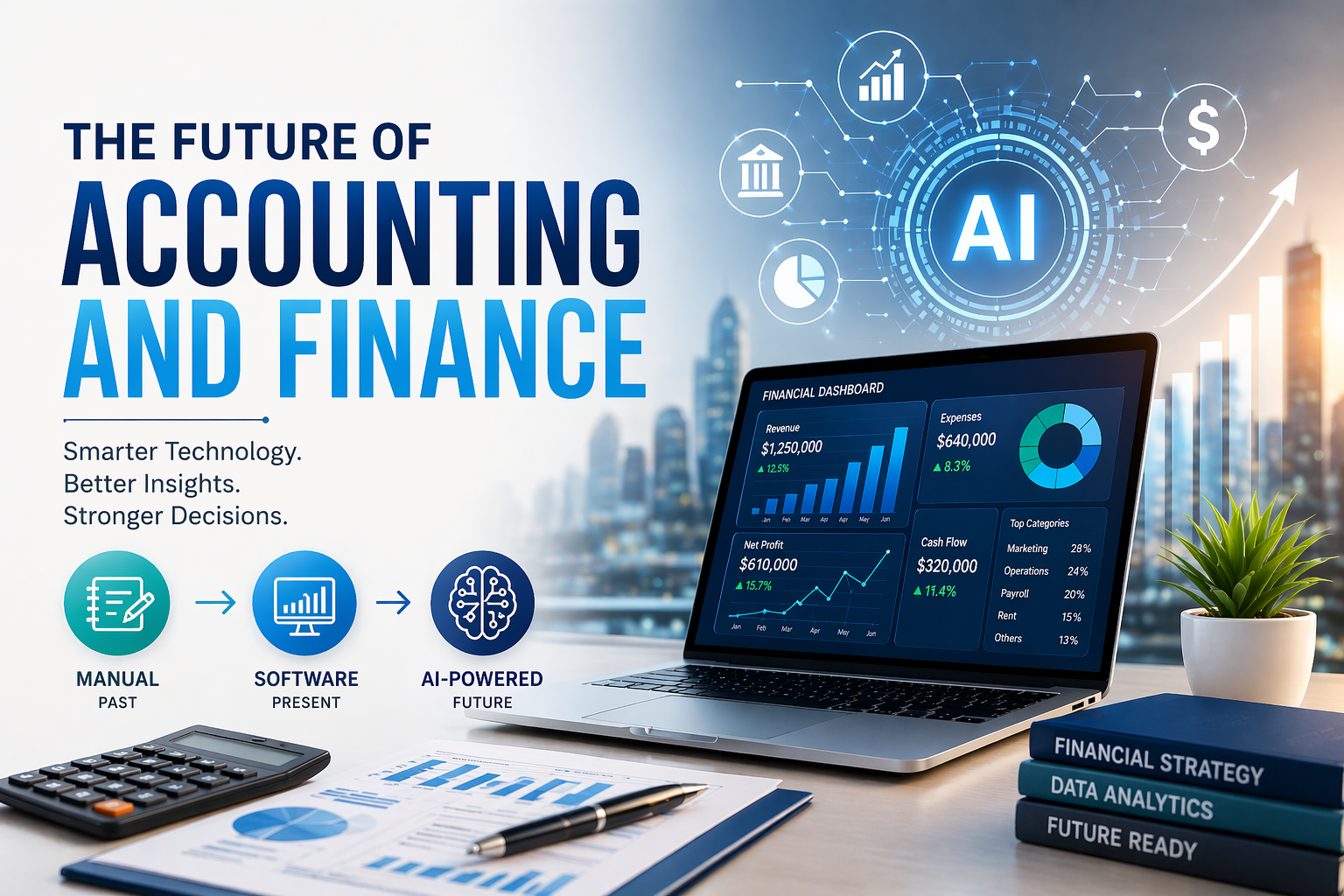
In the past, accounting was highly manual. Transactions were recorded by hand in books, financial statements were prepared manually, and calculations were done using paper, pens, and calculators. This process was time-consuming and prone to human error. Accountants spent much of their time entering data, reconciling balances, and checking figures. While the principles of accounting remained sound, the methods were slow and labor-intensive.
The introduction of accounting software changed the profession dramatically. Programs such as QuickBooks, Sage, Tally, Xero, and ERP systems like SAP made bookkeeping faster, more accurate, and more efficient. Businesses could now automate payroll, generate invoices, track expenses, and produce financial reports instantly. Cloud accounting further revolutionized the industry by allowing accountants and business owners to access records from anywhere in the world in real time.
Software has already reduced many repetitive tasks, but the next phase of change is artificial intelligence. AI is expected to transform accounting and finance more deeply than any previous innovation. Intelligent systems can analyze massive amounts of financial data within seconds, detect fraud patterns, predict cash flow trends, and provide real-time financial insights. Instead of spending hours reviewing transactions, accountants can focus on interpreting data and advising management.
For example, AI-powered tools can automatically categorize expenses, reconcile bank statements, and flag unusual transactions. Machine learning systems improve over time by learning from past data. Chatbots can answer finance-related questions instantly, while predictive analytics can help companies plan budgets and investments more accurately.
The role of accountants will therefore shift from traditional bookkeeping to a strategic business partnership. Future accountants will become advisors who guide companies on profitability, risk management, tax planning, sustainability reporting, and growth opportunities. Skills such as critical thinking, communication, ethics, and technology literacy will become just as important as technical accounting knowledge.
Finance professionals will also benefit from AI. Investment analysis, credit scoring, portfolio management, and financial forecasting will become faster and more precise. Companies will make smarter decisions based on real-time dashboards and automated reports. However, human judgment will remain essential. AI can process information, but humans must apply ethics, context, and professional reasoning.
There will also be challenges. Cybersecurity risks, data privacy concerns, and the need for continuous training cannot be ignored. Accountants must learn to work alongside machines rather than fear them. Professional bodies and universities will need to redesign training programs to include data analytics, automation, and AI tools.
In conclusion, the future of accounting and finance is bright and exciting. The profession is moving from manual records to software automation and now into the age of artificial intelligence. Those who adapt and embrace technology will thrive. Accountants of tomorrow will not merely count numbers—they will create value, guide strategy, and shape the future of business.