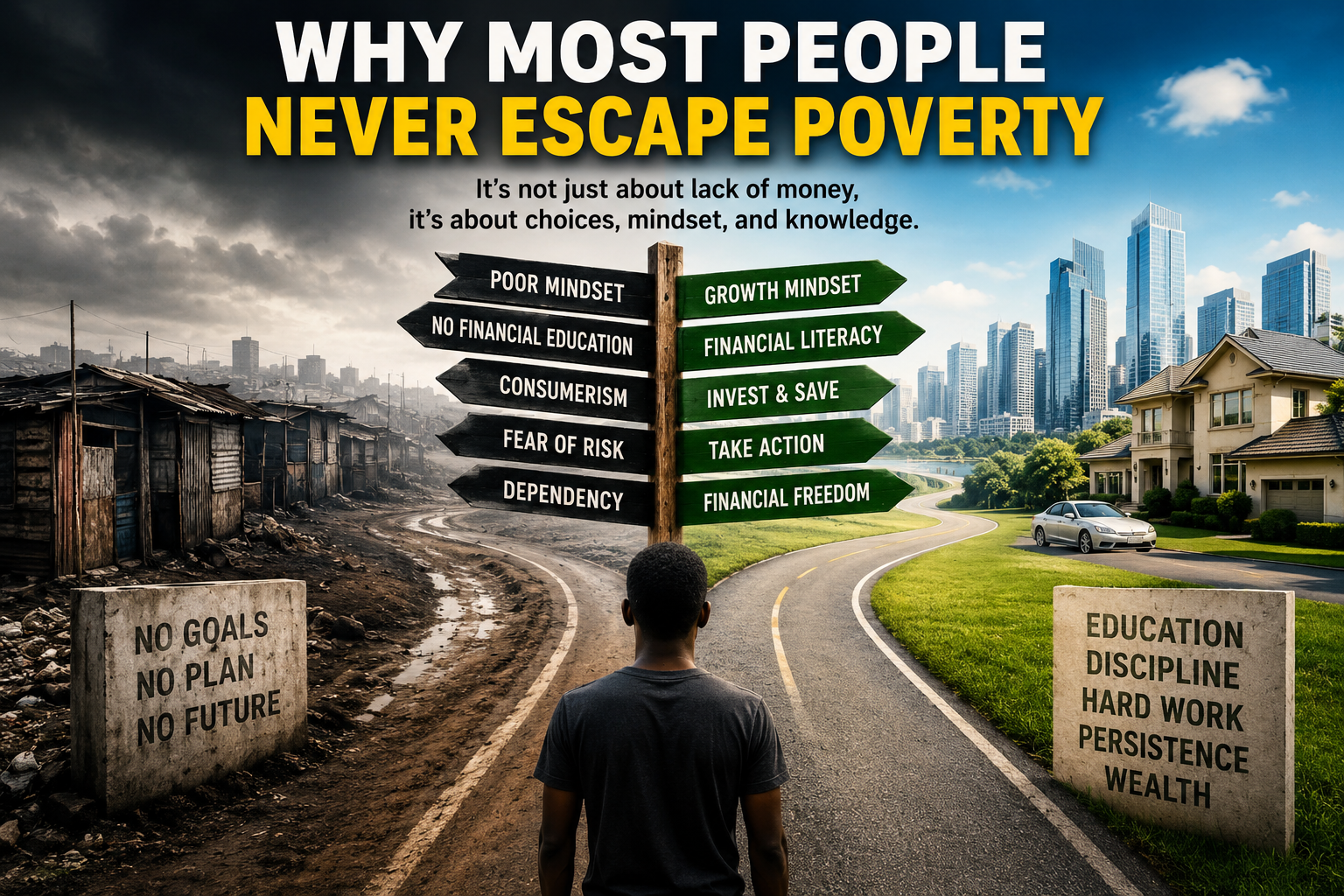
In today’s information age, poverty is no longer caused only by a lack of money. In many cases, it is sustained by a combination of mindset limitations, poor financial habits, lack of access to quality education, bad economic systems, and failure to adapt to changing opportunities. While technology and the internet have created more opportunities than ever before, millions of people remain trapped in cycles of financial hardship.
The painful reality is that many people work hard all their lives yet never truly escape poverty. This raises an important question: why?
Poverty Is More Than Lack of Money
Many people think poverty simply means not having enough money. However, poverty is often deeper than financial shortage. It can involve a lack of information, a lack of opportunities, poor decision-making, low self-belief, and limited exposure to better possibilities.
In the past, information was difficult to access. Today, knowledge is available almost everywhere through smartphones, social media, online courses, YouTube, podcasts, and digital libraries. Yet many people spend hours consuming entertainment while neglecting educational content that could improve their lives.
The information age rewards those who learn quickly, adapt quickly, and use information wisely. Unfortunately, many people are still using modern technology mainly for entertainment instead of empowerment.
Poor Financial Education
One major reason people remain poor is the absence of financial education. Many schools teach students how to pass examinations but fail to teach practical life skills such as budgeting, saving, investing, entrepreneurship, debt management, and wealth creation.
As a result, many people earn income but do not know how to manage it properly. A worker may receive a salary at the end of the month but spend everything within days on unnecessary expenses, luxury lifestyles, and social pressure.
For example, a young professional may earn a decent income but use most of it on expensive phones, designer clothing, parties, and maintaining appearances on social media. Meanwhile, another person earning the same income invests part of it into skills development, stocks, business opportunities, or side hustles. Ten years later, the financial difference between the two individuals becomes enormous.
Income alone does not create wealth. Financial discipline does.
The Trap of Consumerism
Modern society constantly encourages people to consume more. Social media platforms have intensified pressure to appear successful even when people are struggling financially. Many individuals now buy things not because they need them, but because they want validation from others.
The information age has created a culture where people compare themselves daily to influencers, celebrities, and wealthy lifestyles online. This often leads to emotional spending and financial irresponsibility.
Many people fall into debt trying to maintain lifestyles they cannot truly afford. Instead of building assets, they accumulate liabilities.
A person who earns a modest income but lives below their means can gradually build wealth. However, someone who constantly spends everything to impress others may remain financially trapped regardless of income level.
Fear of Taking Risks
Another reason many people never escape poverty is fear. Fear prevents people from trying new opportunities, learning new skills, starting businesses, investing, or changing careers.
The digital economy has created countless opportunities for people to earn income online through freelancing, content creation, e-commerce, consulting, digital products, remote work, and online education. Yet many people ignore these opportunities because they fear failure, criticism, or uncertainty.
For example, some individuals spend years complaining about unemployment while refusing to learn digital skills such as graphic design, programming, digital marketing, bookkeeping, video editing, or content writing. Meanwhile, others who learn these skills are earning income globally from their laptops.
The modern economy rewards adaptability. Those who resist change are often left behind.
Dependency Mentality
Some people remain poor because they constantly wait for external rescue. They depend entirely on governments, employers, family members, or politicians to change their lives.
While support systems are important, lasting financial improvement usually requires personal responsibility and initiative. Successful people often look for ways to create opportunities rather than waiting for opportunities to appear.
This does not mean everyone starts from equal conditions. Some people face serious disadvantages such as poor infrastructure, unemployment, corruption, or family hardship. However, history shows that many people have still managed to rise above difficult circumstances through persistence, education, and strategic thinking.
Lack of Valuable Skills
In the information age, skills are becoming more valuable than certificates alone. Employers and clients increasingly pay for results, creativity, and problem-solving abilities.
A university degree without practical skills may no longer guarantee financial success. Meanwhile, someone with strong digital, technical, or business skills may build a profitable career even without advanced academic qualifications.
Today, people can learn valuable skills online at a low cost or even for free. Yet many refuse to invest time in self-development.
People who continuously improve themselves tend to increase their earning potential over time. Those who stop learning often struggle financially as industries evolve.
Negative Environment and Mindset
The environment also plays a major role in poverty. Individuals surrounded by negativity, hopelessness, and destructive habits may eventually adopt similar thinking patterns.
Some people grow up hearing statements such as:
- “Rich people are dishonest.”
- “Success is impossible.”
- “People from our background cannot prosper.”
- “Business is too risky.”
Over time, such beliefs limit ambition and confidence.
By contrast, people who surround themselves with positive, growth-oriented individuals are more likely to pursue opportunities and believe in long-term success.
Mindset alone will not eliminate poverty, but mindset strongly influences decisions, habits, and persistence.
Conclusion
The information age has created enormous opportunities for those willing to learn, adapt, and take responsibility for their future. While poverty remains a serious global challenge, many people stay trapped not only because of economic conditions, but also because of poor financial habits, lack of education, fear, consumerism, dependency, and resistance to change.
Escaping poverty requires more than hard work alone. It requires financial intelligence, discipline, valuable skills, continuous learning, strategic thinking, and the courage to seize opportunities.
In a world where knowledge is available at the touch of a button, one of the greatest risks today is not lack of opportunity — it is failure to use available information wisely.