Introduction
The 21st-century business environment is characterized by rapid technological advancements, globalization, changing customer expectations, economic uncertainty, and intense competition. Business professionals are expected not only to identify problems but also to develop innovative and sustainable solutions. As a result, problem-solving has become one of the most valuable skills for business students and future leaders.
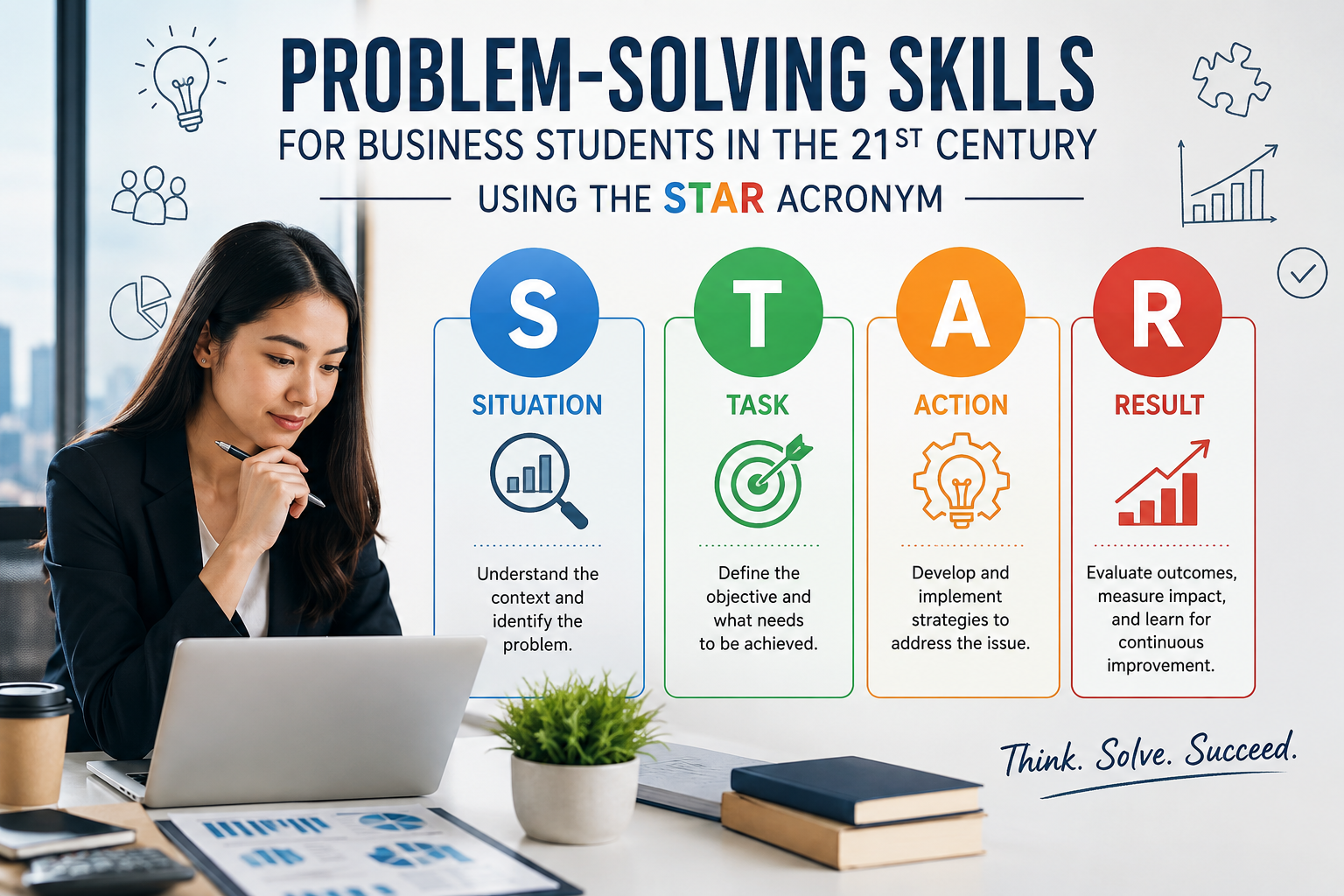
Organizations today seek graduates who can think critically, analyze information, make sound decisions, and implement effective solutions. One practical framework that can help business students develop these competencies is the STAR model: Situation, Task, Action, and Result. While STAR is often used in interviews to describe achievements, it can also serve as a powerful problem-solving methodology.
This article explores how business students can apply the STAR approach to solve complex challenges and enhance their professional effectiveness.
S – Situation: Understanding the Problem
The first step in problem-solving is to clearly understand the situation. Many people rush to provide solutions without fully grasping the nature of the problem. Effective problem solvers take time to gather facts, identify stakeholders, and understand the environment in which the issue exists.
In the modern business world, situations can arise from declining sales, customer complaints, supply chain disruptions, financial losses, employee turnover, or technological changes. Before taking action, students should ask critical questions:
- What exactly is happening?
- When did the problem begin?
- Who is affected?
- What evidence supports the existence of the problem?
- What external factors are influencing the situation?
For example, if a company’s sales have dropped by 20%, the immediate assumption may be poor marketing. However, a deeper analysis may reveal increased competition, changing customer preferences, or product quality issues.
Business students should develop analytical skills through research, data interpretation, market analysis, and observation. Understanding the situation accurately provides a strong foundation for effective decision-making.
T – Task: Defining the Objective
Once the situation has been understood, the next step is to define the task. This involves identifying the specific problem to be solved and establishing clear objectives.
Many business failures occur because organizations focus on symptoms rather than root causes. Defining the task requires narrowing the problem to a manageable and measurable objective.
A good task statement should answer questions such as:
- What needs to be achieved?
- What are the desired outcomes?
- What constraints exist?
- What resources are available?
Suppose an online retail company is experiencing increased customer complaints about delayed deliveries. The task is not merely to “reduce complaints.” A more precise objective would be: “Reduce delivery delays by 30% within six months while maintaining operational costs.”
Clear objectives help focus efforts and prevent wasted resources. For business students, learning how to define problems accurately is a crucial leadership skill. It ensures that teams work toward meaningful and measurable goals.
A – Action: Developing and Implementing Solutions
After defining the task, the next stage involves taking action. This is where creativity, critical thinking, collaboration, and decision-making come into play.
The action phase requires students to:
- Generate possible solutions.
- Evaluate alternatives.
- Select the most effective option.
- Implement the chosen strategy.
- Monitor progress.
In today’s digital economy, action often involves leveraging technology, data analytics, artificial intelligence, automation, and innovative business models.
For example, if customer service response times are too slow, potential actions may include:
- Introducing a customer relationship management (CRM) system.
- Training customer service representatives.
- Implementing chatbots for routine inquiries.
- Redesigning service workflows.
Business students should avoid relying solely on intuition. Instead, they should use evidence-based decision-making. Data analysis, financial modeling, benchmarking, and market research can help identify the most suitable course of action.
Collaboration is equally important. Many business challenges require input from multiple departments, such as finance, marketing, operations, and human resources. Effective problem solvers understand how to work with diverse teams to achieve common objectives.
The action stage transforms ideas into practical solutions and demonstrates leadership, initiative, and accountability.
R – Result: Measuring Outcomes and Learning
The final component of the STAR framework focuses on results. Every problem-solving effort should conclude with an evaluation of outcomes.
Organizations invest resources in solving problems because they expect measurable improvements. Therefore, it is essential to assess whether the implemented solution achieved its intended objectives.
Business students should ask:
- Were the goals achieved?
- What measurable improvements occurred?
- What lessons were learned?
- How can future performance be enhanced?
Results should be quantified whenever possible. Examples include:
- Increased sales by 15%.
- Reduced operating costs by 10%.
- Improved customer satisfaction ratings from 75% to 90%.
- Reduced employee turnover by 20%.
Evaluating results helps organizations identify best practices and areas for improvement. It also promotes a culture of continuous learning and innovation.
In the 21st century, businesses operate in dynamic environments where change is constant. Therefore, successful problem-solving is not a one-time event but an ongoing process of learning, adapting, and improving.
Conclusion
Problem-solving is one of the most essential competencies for business students preparing for careers in today’s complex and fast-changing world. The STAR framework—Situation, Task, Action, and Result—provides a structured and practical approach to addressing challenges effectively.
By understanding the situation, defining clear objectives, taking strategic action, and evaluating results, business students can develop the critical thinking, analytical, and leadership skills demanded by modern employers. Whether managing financial challenges, improving customer experiences, leading organizational change, or launching innovative ventures, the STAR approach equips future business leaders with a reliable roadmap for success.
As businesses continue to face unprecedented challenges and opportunities, those who master problem-solving through the STAR framework will be better positioned to create value, drive innovation, and lead organizations toward sustainable growth in the 21st century.