Introduction
Theory X and Theory Y are theories of human motivation and management in the workplace. They were created by Douglas McGregor while he was working at the Massachusetts Institute of Technology (MIT) Sloan School of Management in the 1950s and were further developed in the 1960s. McGregor’s work was rooted in motivation theory alongside the works of Abraham Maslow, who created the hierarchy of needs. The two theories proposed by McGregor describe contrasting models of workforce motivation applied by managers in human resource management, organizational behavior, organizational communication, and organizational development.
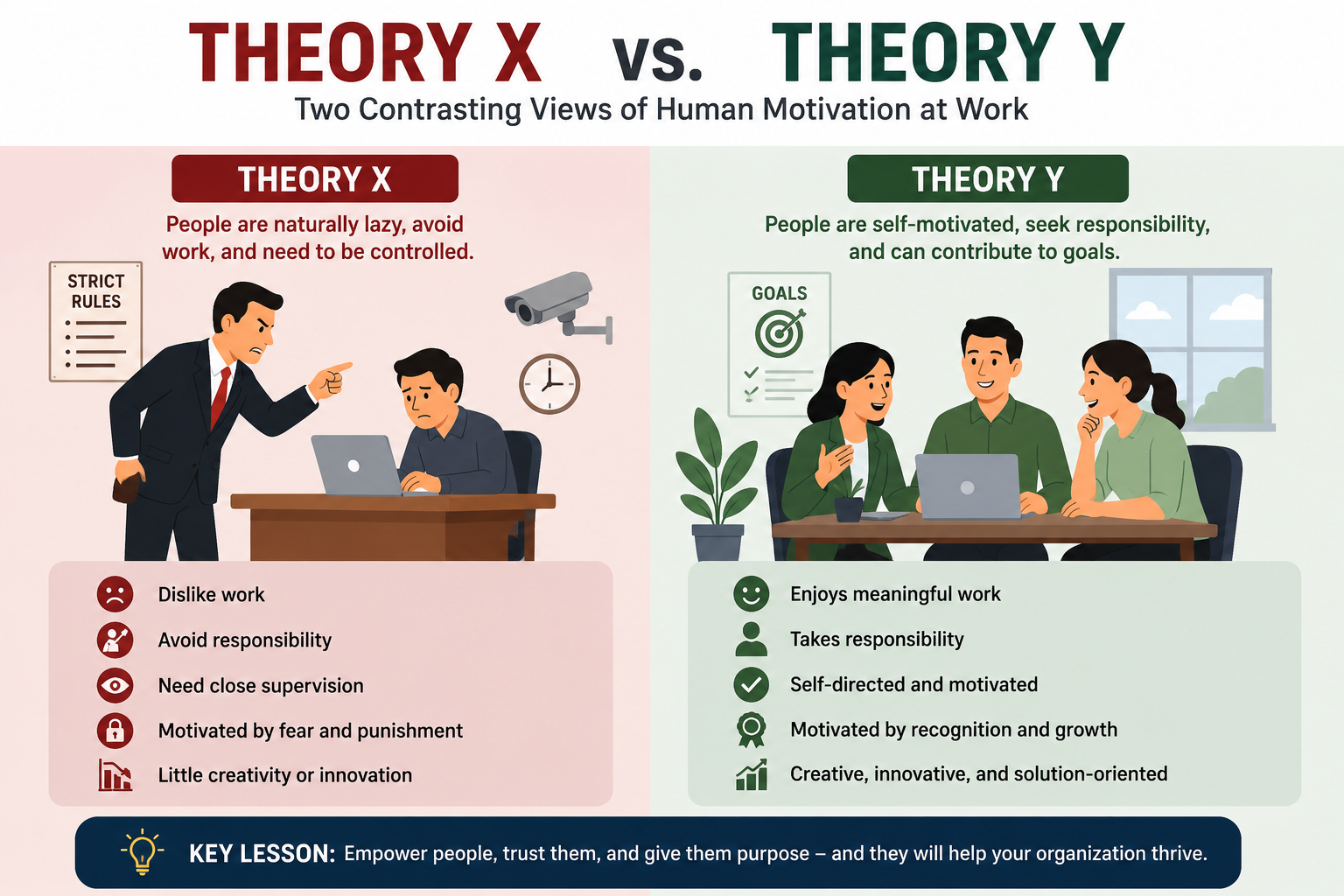
The basic understanding is that people belonging to the Theory X are generally lazy, not ready to take up the challenge unless motivated through punishments and or strict controls. Theory Y assumes that people are generally motivated, self-starters who are ready to take up the challenges without too much supervision, direction, and control.
Let’s look at the two theories in detail.
THEORY X
Theory X is based on assumptions regarding the typical worker. This management style assumes that the typical worker has little ambition, avoids responsibility, and is individual-goal oriented. In general, Theory X-style managers believe their employees are less intelligent, lazier, and work solely for a sustainable income. Management believes employees’ work is based on their own self-interest. Managers who believe employees operate in this manner are more likely to use rewards or punishments as motivation. Due to these assumptions, Theory X concludes that the typical workforce operates more efficiently under a hands-on approach to management. Theory X managers believe all actions should be traceable to the individual responsible. This allows the individual to receive either a direct reward or a reprimand, depending on the outcome’s positive or negative nature. This managerial style is more effective when used in a workforce that is not essentially motivated to perform.
According to McGregor, there are two opposing approaches to implementing Theory X: the hard approach and the soft approach. The hard approach depends on close supervision, intimidation, and immediate punishment. This approach can potentially yield a hostile, minimally cooperative workforce that may cause resentment towards management. Managers are always looking for mistakes from employees, because they do not trust their work. Theory X is a “we versus they” approach, meaning it is the management versus the employees.
The soft approach is characterized by leniency and less strict rules in hopes of creating high workplace morale and cooperative employees. Implementing a system that is too soft could result in an entitled, low-output workforce. McGregor believes both ends of the spectrum are too extreme for efficient real-world application. Instead, McGregor feels that an approach located in the middle would be the most effective implementation of Theory X.
Because managers and supervisors are in almost complete control of the work, this produces a more systematic and uniform product or work flow. Theory X can benefit a workplace that utilizes an assembly line or manual labor. Using this theory in these types of work conditions allows employees to specialize in particular work areas, which in turn allows the company to mass-produce a higher quantity and quality of work.
Theory Y
Theory Y managers assume employees are internally motivated, enjoy their job, and work to better themselves without a direct reward in return. These managers view their employees as one of the most valuable assets to the company, driving the internal workings of the corporation. Employees, additionally, tend to take full responsibility for their work and do not need close supervision to create a quality product. It is important to note, however, that before an employee carries out their task, they must first obtain the manager’s approval. This ensures work stays efficient, productive, and in line with company standards.
Theory Y managers gravitate towards relating to the worker on a more personal level, as opposed to a more conductive and teaching-based relationship. As a result, Theory Y followers may have a better relationship with their boss, creating a healthier atmosphere in the workplace. In comparison to Theory X, Theory Y incorporates a pseudo-democratic environment in the workforce. This allows the employee to design, construct, and publish their work promptly in co-ordinance to their workload and projects.
Although Theory Y encompasses creativity and discussion, it does have limitations. While there is a more personal and individualistic feel, this leaves room for error in terms of consistency and uniformity. The workplace lacks unvarying rules and practices, which could potentially be detrimental to the quality standards of the product and the strict guidelines of a given company.
RECOMMENDED APPLICATION by Silverman
Human beings need motivation in their day-to-day lives. They need what could be described as “sweeteners” or the “icing on the cake” to propel them to the longed-for height. The following is listed as forms of motivation for the one who could be described as Theory X: –
- Understand what moves or breaks the individual. What makes the person happy and unhappy is a catalyst for getting them to do what is required of them. Don’t just leave your employees without knowing what is eating them up.
- It is not sufficient to establish strict rules and close monitoring. The lazy or non-motivated staff should be given equal tasks as those of the Theory Y. Place them in the same environment (office, room, workspace, etc.). The Theory X person is likely to observe how the Theory Y person is working. The learning and the motivation process begins here.
- Motivate the Theory X person by praising them for the little efforts they put in. This goes a long way to let them step up their efforts.
- Have time for both the self-motivated and the lazy ones. Frequently take them out for coffee, lunch, or dinner. At these events, ask about their performance targets and find out how their work could be enhanced. A more relaxed atmosphere of this sort brings the best out of people for them to openly speak out.
- Reward people openly for their great achievements. This encourages other staff to take up the challenge with the hope of getting the same.